

IELTS vs. TOEFL 2025: A Kolkata Consultant's Ultimate Guide to Choosing Your English Test
IELTS vs. TOEFL 2025: The Expert Kolkata Consultant’s Definitive Guide to Choosing Your Global Gateway
Choosing between IELTS and TOEFL can feel overwhelming when you're planning to study abroad. Both tests measure English language proficiency, but they differ significantly in format, scoring, acceptance, and difficulty level. This comprehensive guide will help Indian students understand these differences and make an informed decision about which test aligns best with their goals.
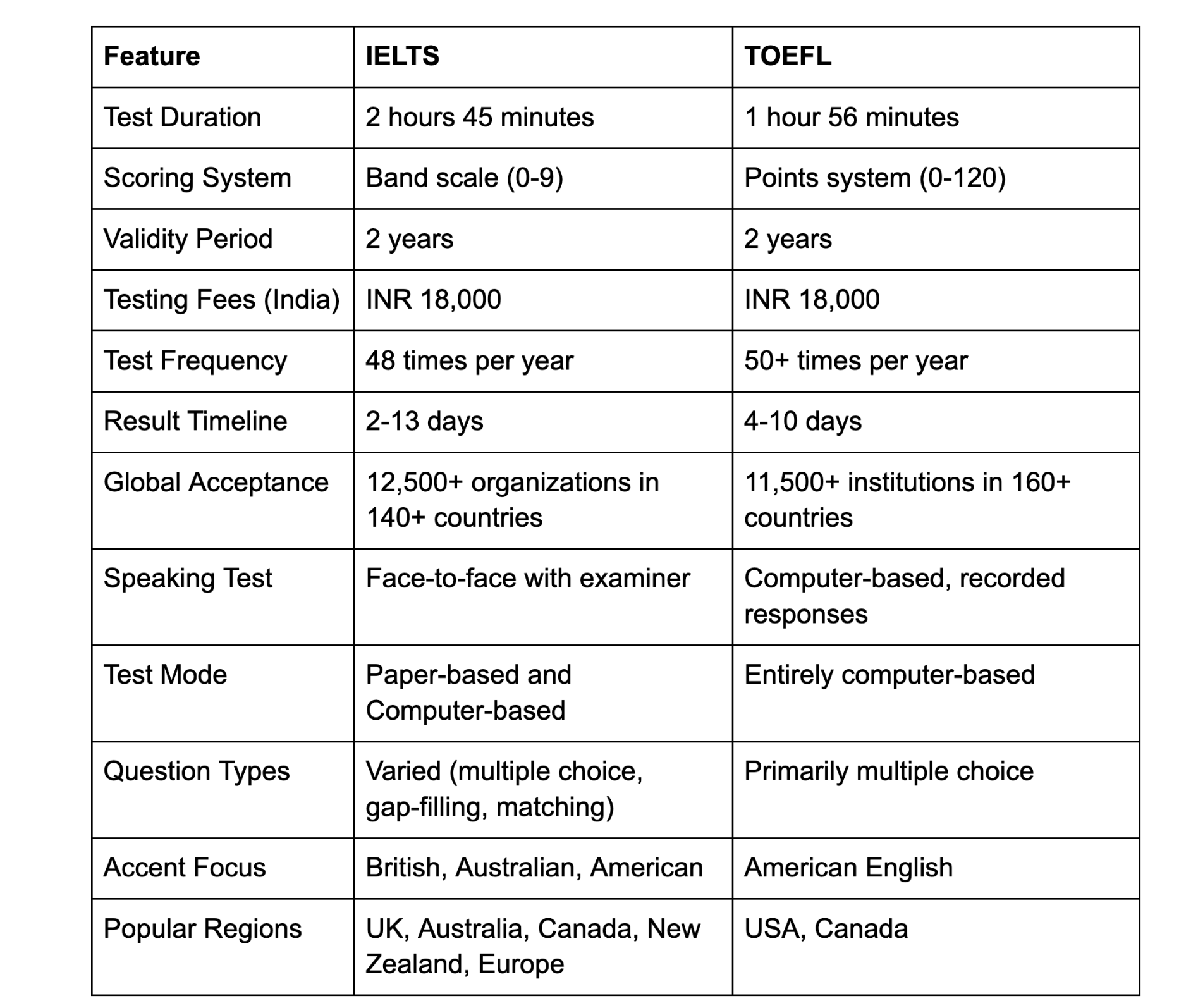
Quick Comparison: IELTS vs TOEFL at a Glance
Understanding the fundamental differences between these two tests is essential before diving deeper. Both IELTS (International English Language Testing System) and TOEFL (Test of English as a Foreign Language) are globally recognized English proficiency tests, but they serve students differently based on their destination countries and learning preferences.
Understanding IELTS: Format, Scoring, and Acceptance
IELTS Test Structure
IELTS is jointly managed by the British Council, IDP Education, and Cambridge Assessment English. The test comes in two versions: IELTS Academic (for higher education) and IELTS General Training (for work experience, training programs, or migration). Indian students typically take the Academic version for university admissions.
The test comprises four sections that assess comprehensive English skills:
Listening Section (30 minutes): Features four recordings with 10 questions each, totaling 40 questions. The first two sections test everyday social contexts, while sections three and four focus on academic settings. Students hear multiple speakers with various accents including British, Australian, and American.
Reading Section (60 minutes): Contains three passages totaling 2,150-2,750 words from books, magazines, journals, and newspapers. The section includes 40 questions with varied formats such as multiple choice, matching headings, true/false/not given, and sentence completion.
Writing Section (60 minutes): Consists of two tasks. Task 1 requires describing visual information like charts, graphs, or tables in 150 words. Task 2 involves writing a 250-word essay responding to an argument or viewpoint.
Speaking Section (11-14 minutes): Conducted as a face-to-face interview with a certified examiner in three parts: general questions about yourself, a 2-minute talk on a given topic, and a detailed discussion related to that topic.
IELTS Scoring System
IELTS uses a band scoring system from 0 to 9, with half-band increments (6.5, 7.0, 7.5, etc.). Each section receives an individual band score, and the overall band score is the average of these four scores, rounded to the nearest half band. For example, if a student scores 7.0 in Listening, 6.5 in Reading, 7.5 in Writing, and 6.5 in Speaking, the overall band would be 6.875, rounded up to 7.0.
IELTS Acceptance Worldwide
IELTS is accepted by over 12,500 organizations across more than 140 countries. The test is particularly preferred in the United Kingdom, Australia, Canada, New Zealand, and most European nations. In the UK, IELTS is required for visa purposes, making it the mandatory choice for students applying to British universities. For Australian and New Zealand universities, IELTS remains the dominant preference, though institutions also accept TOEFL
Best Countries for IELTS
IELTS scores are especially advantageous for students targeting Commonwealth countries and the UK. Most UK universities require an overall band score between 6.0 and 7.0, with top institutions like Oxford and Cambridge requiring 7.0 to 7.5. Australian universities typically require 6.5 for postgraduate programs and 6.0 for undergraduate courses. Canada accepts both IELTS and TOEFL equally, with most universities requiring a minimum of 6.5.
Preparation Timeline for IELTS
The time needed to prepare for IELTS depends significantly on current English proficiency levels. Beginners with band scores around 3-4 need approximately 6-8 months of preparation, while intermediate students scoring 5.5-6.0 require 3-4 months. Advanced learners already scoring 6.5-7.0 may need only 1-2 months of focused practice. Most experts recommend studying 2-3 hours daily for optimal results.
Understanding TOEFL: Format, Scoring, and Acceptance
TOEFL Test Structure
TOEFL iBT (internet-Based Test) is administered by Educational Testing Services (ETS) and is entirely computer-based. The test underwent significant changes in July 2023, reducing its duration from approximately 3 hours to just under 2 hours, making it more student-friendly.
The TOEFL iBT consists of four integrated sections:
Reading Section (35 minutes): Contains 2 passages with 10 questions each, totaling 20 questions. The passages are academic in nature and focus on university-level content with complex vocabulary.
Listening Section (36 minutes): Includes 3 lectures (6 questions each) and 2 conversations between two speakers (5 questions each), totaling 28 questions. All content reflects academic settings similar to university classrooms.
Speaking Section (16 minutes): Features 4 tasks where students speak into a microphone. The first task involves speaking about a familiar topic, while the remaining three are integrated tasks requiring students to read, listen, and then speak.
Writing Section (29 minutes): Comprises two tasks. The integrated task requires reading a passage, listening to a lecture, and then writing a 150-225 word response in 20 minutes. The independent task involves writing a 300-350 word essay on a given topic in about 10 minutes.
TOEFL Scoring System
TOEFL uses a points-based scoring system ranging from 0 to 120, with each section scored from 0 to 30 points. Universities often specify minimum sectional requirements in addition to overall scores. The scoring is holistic for productive skills (speaking and writing), assessing overall proficiency rather than individual components.
TOEFL Acceptance Worldwide
TOEFL is accepted by over 11,500 institutions across 160+ countries. The test is particularly preferred in the United States, where it remains the traditional choice for American universities. More than 100% of UK universities accept TOEFL for Tier 4 student visas, though IELTS is more commonly preferred. In Canada, TOEFL is equally accepted alongside IELTS at all major universities.
Best Countries for TOEFL
TOEFL is the dominant choice for students targeting American universities, especially STEM programs at institutions like MIT, Stanford, Harvard, and Yale. Most US universities require a minimum TOEFL score of 80-100, with prestigious institutions often requiring 100 or higher. Canadian universities typically require 90-100 for undergraduate programs and 100+ for competitive postgraduate courses.
Preparation Timeline for TOEFL
TOEFL preparation time varies based on English proficiency. Beginners require 4-6 months of preparation, while intermediate students need 8-12 weeks (2-3 months). Advanced learners with strong English foundations may need only 6-8 weeks of focused practice. Some students with excellent English skills have even scored 100+ with just one week of preparation, though this is exceptional.
Head-to-Head Comparison: Which Test Should You Choose?
Which Test is Easier?
The question of difficulty is highly subjective and depends on individual strengths. According to recent surveys, approximately 80% of test-takers in global forums consider IELTS easier than TOEFL, especially for reading and speaking sections.
For Indian Students Specifically:
IELTS may be easier if you:
Prefer face-to-face speaking interactions over speaking into a computer
Are comfortable with varied question types including short answers and gap-filling
Find it easier to understand multiple accents (British, Australian, American)
Prefer writing by hand or have the option to choose between paper and computer formats
TOEFL may be easier if you:
Excel at multiple-choice questions and prefer structured formats
Are comfortable with American English and accent
Type faster than you write and prefer entirely computer-based tests
Perform better in academic-focused reading passages
For many Indian students, IELTS reading passages are considered more accessible because they include general content from magazines and newspapers, whereas TOEFL focuses exclusively on academic texts with complex vocabulary. However, TOEFL's speaking section recorded on a computer may feel less intimidating for students anxious about face-to-face conversations.
Scoring and Conversion: Understanding Your Options
Universities often provide equivalent score requirements for both tests. Understanding the conversion helps students determine which test might help them achieve their target more easily:
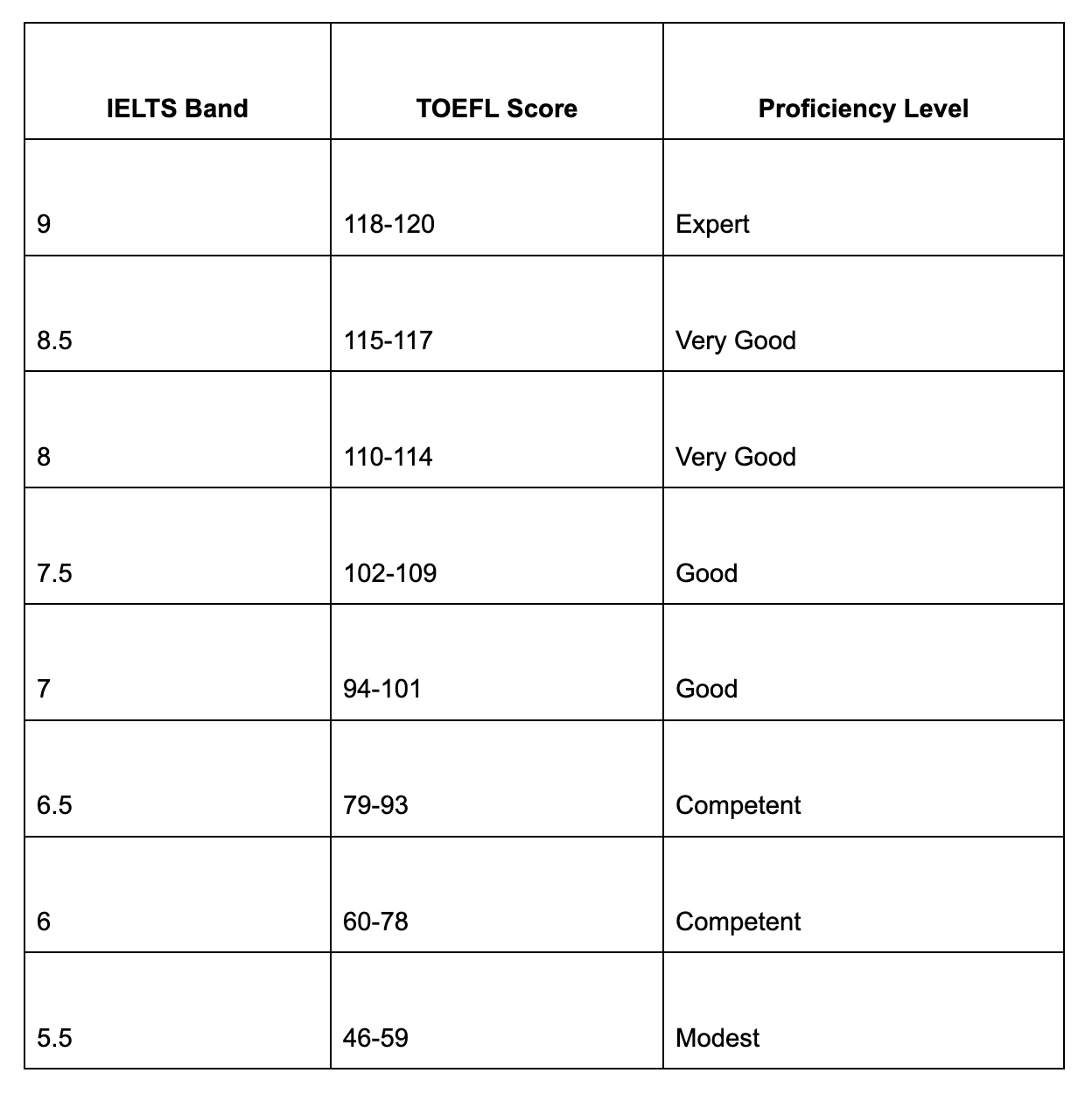
Most competitive universities require IELTS 6.5-7.0 or TOEFL 79-100 for admission. For prestigious institutions like Oxford, Cambridge, Harvard, or MIT, students typically need IELTS 7.5+ or TOEFL 100+.
Country-Specific Acceptance: Where Does Each Test Work Best?
United States: While TOEFL is the traditional preference for American universities, IELTS acceptance has grown significantly. Over 3,000 US institutions now accept IELTS scores. However, TOEFL remains more common, especially at top-tier universities and for STEM programs.
United Kingdom: IELTS dominates UK admissions due to its British origins and visa requirements. IELTS for UKVI (UK Visas and Immigration) is specifically required for UK student visa applications. While 100% of UK universities accept TOEFL, IELTS remains the preferred and more familiar choice.
Canada: Canadian universities show no preference, accepting both tests equally. Students can choose based on personal comfort rather than institutional requirements. The minimum required scores are typically IELTS 6.5 or TOEFL 90-100.
Australia and New Zealand: IELTS is strongly preferred in both countries due to regional affiliations. Australian immigration specifically recognizes IELTS for visa purposes, with scores valid for three years for skilled migration applications (versus the standard two years).
Europe: IELTS is more commonly preferred across European universities, though both tests are generally accepted.
Can You Take Both Tests?
Yes, absolutely! There is no restriction preventing students from taking both IELTS and TOEFL. Some students strategically take both tests to see where they score better, then submit their strongest result to universities. This approach offers several advantages:
Maximizes chances of achieving required scores
Keeps options open for universities in different countries
Allows students to play to their strengths in different test formats
Provides backup options if one test result is unsatisfactory
However, cost considerations are important. Taking both tests means paying INR 36,000 in total (INR 18,000 for IELTS + INR 18,000 for TOEFL). Students should weigh this investment against the potential benefits of having multiple valid scores.
Retaking the Tests: Policies and Strategies
IELTS Retake Policy: Students can retake IELTS as many times as they wish with no waiting period between attempts. Results are typically available within 2-13 days depending on whether you take the computer-delivered (2 days) or paper-based test (13 days). The test can be rebooked immediately if needed.
TOEFL Retake Policy: TOEFL allows unlimited retakes with a mandatory 3-day (72 hours) waiting period between test dates. Results are available within 4-10 days after the test. Students can register for multiple future test dates simultaneously as long as they are at least 3 days apart.
Both tests have the same validity period of 2 years from the test date. After this period, scores expire and students must retake the exam if they need to submit scores for applications.
Frequently Asked Questions (FAQs)
What is the minimum score required for university admission?
Minimum scores vary by institution and program. Generally, undergraduate programs require IELTS 6.0-6.5 or TOEFL 70-80, while postgraduate programs require IELTS 6.5-7.0 or TOEFL 80-100. Top-tier universities often require IELTS 7.0-7.5 or TOEFL 100-110.
How long does it take to prepare for these tests?
Preparation time depends on your current English proficiency. Beginners need 4-8 months, intermediate students require 2-4 months, and advanced learners need 1-2 months of focused preparation. Consistent daily study of 2-3 hours is recommended for optimal results.
Can I retake the test if I'm not satisfied with my score?
Yes, both tests can be retaken multiple times. IELTS has no waiting period, while TOEFL requires a 3-day gap between attempts. Universities typically consider your highest score, so retaking poses no disadvantage.
Which test is accepted for immigration purposes?
IELTS General Training is widely accepted for immigration to Canada, UK, Australia, and New Zealand. TOEFL is not accepted by Canadian and UK immigration departments for migration purposes. For work visas and permanent residency, IELTS is the preferred choice.
How much do these tests cost in India?
IELTS costs INR 18,000 for both Academic and General Training versions. TOEFL iBT costs INR 18,000 for both test center and at-home editions. Additional charges apply for services like late registration, rescheduling, or score reviews.
Which test has better acceptance in Canada?
Canada accepts both IELTS and TOEFL equally for university admissions. However, for immigration and permanent residency, IELTS is required as TOEFL is not accepted by Immigration, Refugees and Citizenship Canada (IRCC).
Can I use a mix of British and American English in my test?
IELTS is more lenient, allowing students to use either British or American English consistently throughout the test. TOEFL typically expects American English usage, though mixing is not heavily penalized. For best results, maintain consistency in spelling and usage.
How are the speaking sections different?
IELTS Speaking is a face-to-face conversation with a certified examiner lasting 11-14 minutes, conducted in a private room. TOEFL Speaking involves speaking into a microphone with responses recorded and evaluated digitally, lasting 16-20 minutes. Many Indian students find IELTS Speaking more natural and conversational.
Which test has more test centers in India?
Both tests are widely available across India. IELTS is offered 48 times per year at numerous test centers in major cities. TOEFL is available 50+ times annually at test centers throughout the country, plus the at-home option. Students in smaller cities may find IELTS more accessible.
Do I need both tests for different universities?
Generally, no. Most universities accept either IELTS or TOEFL, so you only need one valid score. However, check specific requirements for your target institutions, as some may have preferences. Having both scores can maximize your application options.
How quickly can I get my test results?
IELTS computer-delivered test results are available in 2 days, while paper-based results take up to 13 days. TOEFL results are typically available within 4-10 days after the test date. Both tests send official score reports directly to institutions you designate.
Which test is better for engineering students?
TOEFL is often preferred by engineering students, particularly those targeting US universities, as it focuses on academic English with content similar to university lectures. However, both tests are equally valid, and the choice should be based on personal comfort with test format rather than field of study.
Making Your Decision: Practical Recommendations for Indian Students
Choose IELTS If You're Applying To:
UK universities (required for UK visa)
Australian or New Zealand institutions
European universities
Commonwealth countries
Immigration or work visa programs in UK, Canada, or Australia
Choose IELTS If You Prefer:
Face-to-face speaking tests with real examiners
Varied question types beyond multiple choice
Option to take paper-based or computer-based test
British/Australian English and multiple accents
Shorter overall test with no integrated tasks
Choose TOEFL If You're Applying To:
US universities, especially for STEM programs
Top American institutions (MIT, Stanford, Harvard)
MBA programs at American business schools
Institutions that specifically prefer or require TOEFL
Choose TOEFL If You Prefer:
Entirely computer-based testing
Multiple-choice question format
Speaking into a microphone rather than face-to-face
American English and accent
Integrated academic tasks similar to university work
Shorter test duration (under 2 hours)
Cost Comparison and Value
Both the tests, TOEFL and IELTS cost INR 18,000, since there is no difference in cost, consider other factors:
Additional costs for IELTS:
Late registration: varies by test center
Rescheduling: limited refund if done 5+ weeks before test
One Skill Retake: INR 12,000
Additional costs for TOEFL:
Late registration: INR 3,900 extra
Rescheduling: INR 5,900
Score review: INR 7,900 per section
Additional score reports: INR 1,950 per institution
Final Recommendations: Your Path Forward
The choice between IELTS and TOEFL ultimately depends on your target destination, personal strengths, and test-taking preferences. There is no universally "better" test—only the test that's better for you.
Start with these steps:
Check university requirements: Visit the websites of your target universities to see which tests they accept and their minimum score requirements. This is your most important consideration.
Take practice tests for both: Complete at least one full practice test for each exam to understand which format feels more comfortable.
Assess your strengths: Are you better at typing or writing? Do you prefer speaking to people or computers? Do multiple-choice questions suit your style?
Consider your destination: If you're definitely going to the UK, IELTS is the clear choice. For the US, TOEFL has a slight edge but IELTS is increasingly accepted.
Evaluate preparation time: Give yourself adequate preparation time based on your current English level—rushing either test rarely leads to optimal results.
Remember, both tests are valid proof of English proficiency accepted by thousands of institutions worldwide. Your success depends more on thorough preparation than on choosing between IELTS and TOEFL. With consistent effort and the right study approach, Indian students can achieve excellent scores on either test and fulfill their study abroad dreams.
Still unsure which test to take? Consider scheduling a free consultation with a study abroad counselor at Whiteboard Consultants who can evaluate your specific situation and recommend the best path forward based on your target universities, career goals, and personal strengths.
Conclusion
Both IELTS and TOEFL serve as reliable measures of English language proficiency for students aspiring to study abroad. While IELTS offers flexibility with its paper-based option and face-to-face speaking test, TOEFL provides an entirely digital experience aligned with modern academic environments. Indian students should prioritize understanding their target universities' requirements, assessing their own test-taking strengths, and allowing adequate preparation time. With proper planning and dedicated preparation, success on either test is achievable, opening doors to world-class education opportunities across the globe. The key is not finding the "easier" test, but rather the test that aligns best with your destination, preferences, and abilities. Start your preparation early, practice consistently, and approach the test with confidence—your study abroad journey begins with this important first step.